Business Grants for Women: Private vs. Government Options
Women-owned businesses do not have a “funding problem.” They have a capital access problem dressed up as a motivational poster.
Here’s the strategic read: business grants for women can be useful capital, but they are not a funding strategy by themselves. They are a tactical add-on. A non-dilutive boost. A way to buy inventory, fund a pilot, upgrade equipment, or validate traction without handing over equity or taking on debt.
But private grants and government grants are not the same asset class. Treating them like they are is how founders waste six months chasing the wrong money.
Federal grants are not startup fairy dust
Let’s kill the myth cleanly: the U.S. federal government does not hand out “free money” to start or expand a typical small business.
Most federal grants go to nonprofits, educational institutions, state and local governments, or businesses doing scientific research and development through programs like SBIR and STTR. If you are launching a bakery, a consulting firm, a coaching practice, a skincare brand, a childcare center, or an e-commerce shop, federal grants are usually not your lane.
That does not mean government funding is useless. It means the word “grant” is doing too much work.
For female founders, government-linked funding often shows up through:
- State and local economic development programs.
- Procurement opportunities for certified women-owned businesses.
- SBA-backed loan education and lender connections.
- Research and innovation grants for companies with technical R&D.
- Workforce development or community-impact programs tied to specific outcomes.
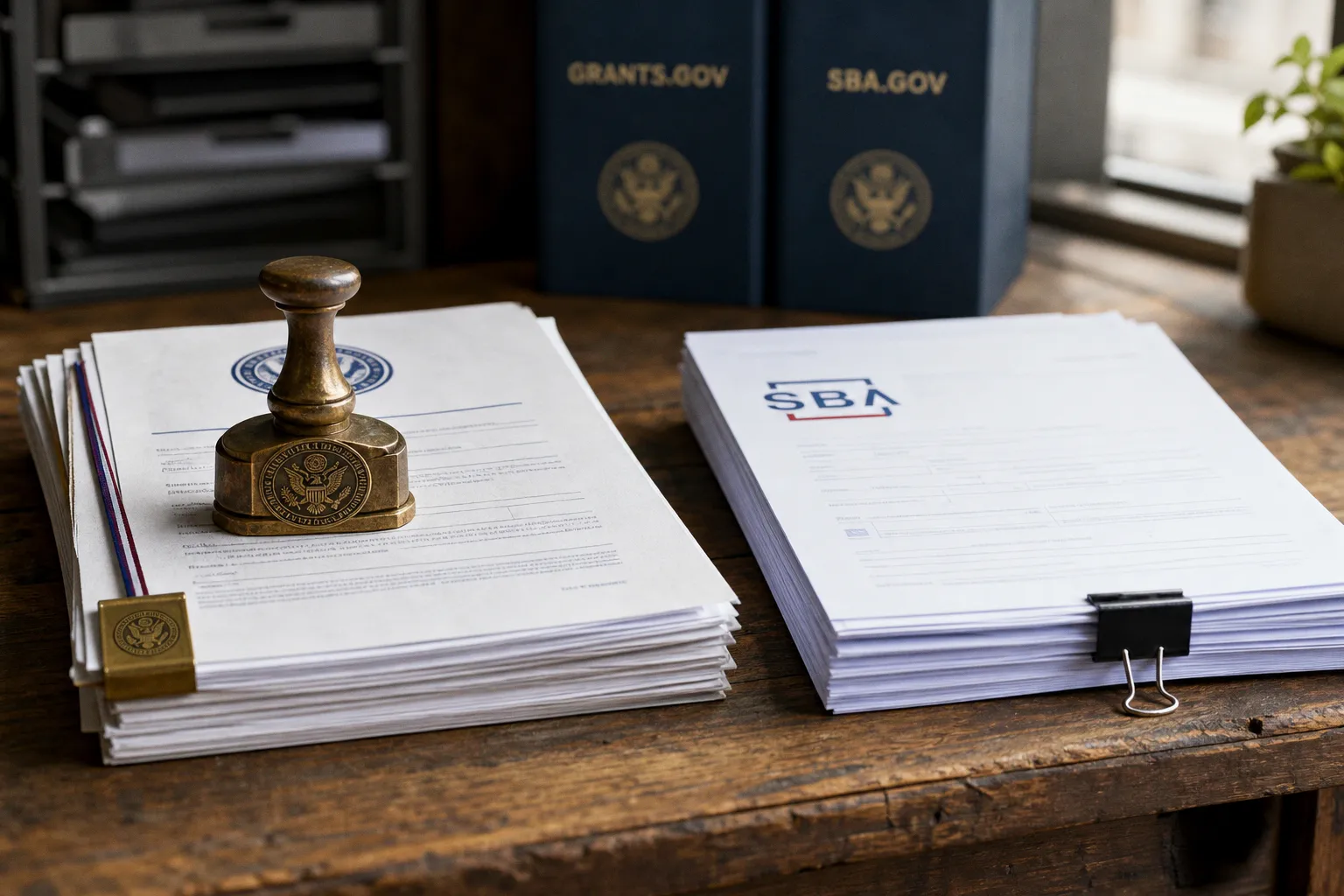
The official federal database for grant opportunities is Grants.gov. SBA.gov is the better starting point for state and local small business funding resources. Neither should be confused with a magic portal where a general small business enters its EIN and exits with a check.
Federal grants reward mission fit. Private grants often reward momentum, story, and market proof. Mix those up and your application ROI collapses.
The strategic mistake I see: founders search “government grants for female business owners,” find a bloated listicle, and start applying without checking whether the money is actually designed for their business model. That is not scrappy. That is unpaid labor with a low close rate.
If a grant is built for biomedical research, clean energy commercialization, rural broadband, or university-linked innovation, your women-owned candle company is not “almost eligible.” It is outside the mandate.
That matters because grant applications cost time. Time is capital. Founder attention is capital. If you spend 20 hours on an application with zero strategic fit, you did not apply for free money. You burned operating capacity.
Private grants are more accessible — but still not easy money
Private grants for women entrepreneurs are usually funded by corporations, foundations, business organizations, or mission-driven private programs. Think Amber Grant, FedEx-style small business competitions, Tory Burch Foundation-linked opportunities, and niche programs tied to industry, geography, identity, or community impact.
These grants often range from $500 to $50,000 per award. That spread matters. A $500 microgrant can buy software, packaging, ads for a test campaign, or professional photography. A $10,000 to $50,000 award can shift cash flow, fund inventory, support hiring, or extend runway.
But private grants are not charity. They are brand strategy, ecosystem building, impact investment, PR, and founder pipeline development wrapped into a funding program.
That means your application has to do more than say, “I need money.”
It has to show:
- Why this business is already moving.
- What the grant will unlock next.
- Why you are the operator to bet on.
- How the funder’s mission maps to your work.
- What measurable result the money can create.
Private grants are often friendlier to early-stage companies than federal grants. They may ask for revenue, community impact, a business plan, customer proof, or a clear use of funds — but they usually do not require the same technical compliance burden as federal programs.
That accessibility is the upside. The downside: private grant markets are fragmented. Deadlines shift. Criteria vary wildly. Success rates are rarely disclosed. Some programs are effectively pitch competitions. Others prioritize geography, product category, founder identity, social impact, or business maturity.
So yes, private grants can be a smarter target for many women-owned businesses. No, they are not predictable operating capital.
Private vs. government grants: the real comparison
| Parameter | Private grants for women entrepreneurs | Government grants for female business owners |
|---|---|---|
| Best fit | Early-stage or growing businesses with a clear story, traction, community impact, or market potential | Research-heavy, nonprofit, educational, public-sector, or sector-specific projects |
| Typical award size | Often $500 to $50,000 | Varies widely, but federal grants are usually tied to formal programs and strict mandates |
| Repayment | No repayment | No repayment |
| Application burden | Usually lighter, but competitive and narrative-heavy | Often complex, compliance-heavy, and highly specific |
| Startup accessibility | Often more realistic for ordinary small businesses | Usually poor for general startups |
| Selection logic | Momentum, mission fit, founder story, business use case | Program mandate, technical eligibility, public purpose |
| Main risk | Wasting time on low-fit competitions or vague criteria | Chasing “free money” that your business was never eligible for |
| Scam exposure | Fake grant pages, fee requests, impostor programs | Fake government-lookalike sites and “processing fee” scams |
The correct question is not “Which one is better?” The correct question is: Which funding source matches your business stage, sector, and next milestone?
If you run a consumer brand with $80,000 in annual revenue and need capital for a production run, a private grant with a clear small business focus may be worth the shot. If you run a biotech startup developing patentable technology, federal R&D programs may belong in your capital stack. If you run a local service business, your best government-adjacent path may be city programs, procurement, or local economic development funds — not federal grants.
The 51% rule is not decoration
Many women-specific funding and certification programs use a core threshold: the business must be at least 51% owned, operated, and controlled by women.
Read that again. Owned is not enough.
If you own 51% on paper but your male co-founder controls finances, operations, vendor contracts, or strategic decisions, that can create problems for certification and eligibility. Funders are not just checking the cap table. They are checking control.
This matters especially when founders split equity casually at launch. A common mistake: a woman starts the company, brings in a partner, gives away too much equity too early, then discovers later that she no longer qualifies for women-owned business funding options.
That is expensive.
Your ownership structure is not just legal housekeeping. It is a funding lever. It affects:
- Grant eligibility.
- Women-owned business certification.
- Procurement access.
- Investor optics.
- Decision rights.
- Long-term wealth capture.
If you are pre-launch or early-stage, design the equity structure like it matters — because it does. If you are already operating, review your documents before applying to women-specific grants. Operating agreement. Cap table. Tax records. Bank authority. Management roles. Who signs contracts. Who controls the money.
Do not wait until a grant application asks for proof.
Your ownership percentage is part of your comp package. Protect it with the same aggression you bring to salary negotiation.
For solopreneurs, this is cleaner. For partnerships, it gets messy fast. If the brand is built on your expertise, your network, your labor, your audience, and your risk, do not casually hand away control for a “helpful” co-founder who has no cash in the game and no clear deliverables.
Equity is the most expensive currency you have.
How to find legitimate grants without getting played
The grant market attracts scammers because the emotional hook is perfect: ambitious founders, cash pressure, and the phrase “free money.”
We are not doing naïve.
Most legitimate government grant applications are free to submit. Many legitimate private grant programs are also free. A request for an “application fee,” “processing fee,” “guarantee fee,” or “release fee” is a red flag. Not a yellow flag. Red.
A real grant program may require documentation, essays, financials, pitch materials, tax information, ownership proof, or reporting after the award. It should not require you to pay to access the award.
Use a tight filter before you spend founder time.
1. Verify the source before you write a word.
Federal opportunities belong on official government platforms. State and local programs should trace back to actual government or economic development entities. Private grants should be hosted by a real corporation, foundation, or known organization with a public track record.
2. Match the eligibility line by line.
Do not “shoot your shot” when the criteria clearly exclude you. If it says revenue stage, geography, industry, years in business, nonprofit status, or research focus, believe it.
3. Check whether the grant fits the next business milestone.
A strong application makes the money feel useful and immediate. “We need funds to grow” is weak. “This $10,000 funds tooling for our second production run after selling out the first 1,200 units” is stronger.
4. Look for proof of past winners.
Legitimate private grant programs often showcase prior recipients. Study them. Not to copy their language — to understand what the funder values.
5. Protect your financial data.
Some applications require revenue or tax details. Fine. But do not send sensitive information into a random form with no clear operator, no privacy terms, and no legitimate organizational footprint.
6. Never pay to apply.
If the program asks for a fee to submit or unlock funding, walk away. Your capital stack does not need a scam tax.
The better your business records, the faster this gets. Keep a grant folder ready: founder bio, business description, ownership proof, revenue snapshot, use-of-funds paragraph, customer proof, press mentions, community impact metrics, product photos, and a clean one-page overview.
That is not busywork. That is deal readiness.
Amber Grant vs. federal grant: different games, different scorecards
Search demand loves the phrase “amber grant vs federal grant” because founders want a clean winner. But these options are built for different playing fields.
The Amber Grant is an example of a private grant model aimed at women-owned businesses. The application tends to be more founder- and business-focused than federal R&D grant structures. It is closer to a small business funding opportunity than a government compliance project.
Federal grants, by contrast, are tied to public objectives. They are not designed to make every promising founder whole. They fund specific missions. The mission comes first; your business comes second.
Here is the tactical difference:
- With a private women-focused grant, your job is to prove traction, clarity, impact, and smart use of funds.
- With a federal grant, your job is to prove eligibility, program alignment, technical or public-purpose fit, and compliance capacity.
That distinction changes the application strategy.
For a private grant, sharpen the narrative around the business case:
- What do you sell?
- Who buys it?
- What proof do you have?
- What constraint is capital solving?
- What happens 30, 60, or 90 days after the award?
For a federal grant, sharpen the mandate match:
- Does your project fit the exact program purpose?
- Are you the eligible type of applicant?
- Can you meet reporting requirements?
- Is the work technical, scientific, educational, public-sector, or otherwise aligned?
- Do you have the administrative capacity to manage the award?
Do not use the same application brain for both. Private grants often reward concise conviction. Government grants reward precision and fit.
And if you are not in a federal-grant-friendly category, that is not a failure. It is portfolio management. Put your time where the odds and fit are better.
Grants belong in the capital stack — not at the center of it
A grant has a beautiful feature: 0% interest and no repayment. That makes it attractive capital.
But attractive does not mean dependable.
A serious founder builds a capital stack. Grants can sit inside it, but they should not carry the whole structure. Depending on your model, your funding mix might include revenue, customer deposits, preorders, business credit, microloans, SBA-backed lending, angel investment, crowdfunding, vendor terms, retained earnings, or strategic partnerships.
Grants are supplemental capital. Treat them like upside, not oxygen.
If your business only survives if you win a grant, the business is undercapitalized. That is not a moral judgment. It is a finance problem. Fix the financing plan.
Use grants for targeted leverage:
- Buy equipment that increases production capacity.
- Fund a marketing test with measurable customer acquisition data.
- Cover certification, packaging, or compliance costs.
- Hire short-term expert help for a defined deliverable.
- Build a prototype or pilot that opens a larger funding conversation.
- Extend runway while revenue ramps, without giving up equity.
Bad use of grant funds: vague growth, founder rescue, scattered expenses, or plugging a business model that does not convert.
Good use of grant funds: one constraint, one deployment plan, one measurable business outcome.
This is where women founders need to get more ruthless. We are often trained to over-explain worthiness. Stop. Funders do not need your entire life story. They need to see an operator with a clear plan for capital.
Lead with business mechanics. Add mission where it strengthens the case. Do not substitute emotion for numbers.
The application that actually competes
A competitive grant application reads like a mini investment memo, not a diary entry.
The funder should understand the business in under one minute. What you do, who pays, why now, what traction exists, what the money unlocks, and why you are credible.
Use this structure when the application gives you room:
1. Business in one sentence.
“We produce allergen-friendly snack boxes for corporate offices and have generated repeat orders from 23 local employers in our first year.”
2. Traction.
Revenue, customers, waitlist, reorder rate, sell-through, partnerships, testimonials, pilot results. Use real signals. If you are pre-revenue, use proof of demand: letters of intent, deposits, audience size, beta users, or signed distribution conversations.
3. Constraint.
Name the bottleneck. Inventory. Equipment. Packaging. Certification. Software. Staffing. Distribution. Do not say “funding.” That is lazy. Say what funding solves.
4. Use of funds.
Tie the amount to a specific spend. “$7,500 covers commercial refrigeration, which increases weekly production capacity from farmers market volume to wholesale order volume.”
5. Outcome.
Show what changes after the grant. More units. More customers. Higher margin. New channel. Faster fulfillment. New hires. Community impact. Measurable, not mystical.
6. Founder edge.
Why you can execute. Industry experience, technical skill, lived market insight, operator track record, distribution advantage, existing customer trust.
Notice what is missing: pleading.
You are not asking to be saved. You are offering the funder a high-ROI deployment of non-dilutive capital.
That posture changes the writing.
Where private and government options fit by business stage
The right funding source depends on where the business actually is, not where your ambition wants it to be.
Idea stage
Private microgrants may be worth testing if they accept pre-revenue founders. Local entrepreneurship competitions can also fit. Federal grants usually do not, unless the idea is tied to eligible research, public purpose, or a formal institution.
Your better move: validate demand before chasing applications. Landing five paying customers often beats submitting five grant essays.
Early revenue
This is the strongest zone for many private grants for women entrepreneurs. You can show proof, but the business still has obvious capital constraints. Use applications to fund a narrow growth unlock.
Government options may exist locally, especially if your business supports job creation, underserved communities, main street revitalization, or specific regional goals.
Growth stage
Private grants can still help, but the award size may be small relative to your needs. At this point, grants are tactical: equipment, market expansion, hiring support, certifications, or special projects.
Government contracting and certification may become more valuable than grants. A women-owned business certification can open doors to procurement opportunities, depending on your industry.
Research or technical innovation
Federal programs may become relevant if your company is doing scientific R&D or technology commercialization. This is where SBIR/STTR-style funding can enter the conversation. The bar is higher, the process is more technical, and the compliance load is real.
If your business is eligible, federal funding can be powerful. If it is not, stop trying to force the fit.
The ruthless decision filter
Before applying for any grant, run the opportunity through this capital allocation filter:
- Fit: Are you clearly eligible, or are you rationalizing?
- Time cost: How many hours will the application take?
- Award size: Is the possible funding meaningful relative to the work?
- Use case: Can you deploy the money into one measurable business outcome?
- Credibility: Is the grant provider legitimate and fee-free?
- Timing: Does the deadline align with your actual business needs?
- Reuse value: Can the application materials be repurposed for other grants, lenders, pitch decks, or partners?
That last point matters. A grant application has better ROI when it forces you to build reusable assets: a cleaner business narrative, sharper financial snapshot, stronger founder bio, clearer impact metrics.
Even if you lose, you should walk away with better funding materials.
If the application produces nothing reusable and the fit is weak, pass. Opportunity cost is real. You do not need more tasks. You need leverage.
The bottom line: choose the money that matches the mandate
Business grants for women can be smart non-dilutive capital. But the phrase covers wildly different funding pools.
Private grants are often the better first target for women-owned small businesses with traction, a strong founder story, and a clear use of funds. Government grants are not general startup cash; they are mission-specific, often technical, and frequently built for institutions or specialized projects. State and local programs may be more relevant than federal ones for many founders.
The power move is not applying everywhere. It is building a disciplined grant pipeline: legitimate opportunities, strong fit, no fees, reusable materials, and a capital plan that does not depend on winning.
Use grants like a strategist. Not like a lottery ticket.
Here is the copy-paste application spine I want you to use:
“Our business is [one-sentence description] serving [specific customer]. We have achieved [traction proof], and our current growth constraint is [specific bottleneck]. A grant of [$X] would fund [specific use], allowing us to [measurable outcome] within [timeframe]. As a [woman-owned / 51% woman-owned] business led by [founder credibility], we are positioned to turn this capital into [business result + relevant impact].”
Cut the fluff. Show the math. Ask for the money like an operator.